Packaging & Materials
Gingerlily and the Packaging Needs of Delicate Textiles
A fine textile asks little of its packaging, in theory: keep it clean, keep it intact, and do not make the journey harder than it needs to be. In practice, the decisions behind a paper bag or protective insert involve a careful balance of material, size, handling, presentation, and what happens when the wrapping is no longer wanted.
There is a particular vulnerability to a folded piece of silk. It is not necessarily fragile in the sense of being about to disintegrate; good fabric can be remarkably resilient. But its surface may catch, crease, snag, or collect dust in ways that a more forgiving material does not. A premium textile arrives with an expectation attached to it: that the object will be treated as something worth noticing. Packaging, then, is not merely the container that survives the trip from shop to home. It is the first part of the product’s afterlife.
Gingerlily offers a useful reference point for thinking through that responsibility. The name is associated here with silk products, including silk laundry bags designed for travel and delicate storage. That does not tell us what packaging the brand uses for every item, nor does it establish a single correct format. It does give retailers a practical question to consider: what does a delicate textile need from the outer package, and what should the package avoid doing?
The answer depends on the item, the route it takes, and the person who opens it. A scarf sent through the post has different needs from a garment carried home from a boutique. A textile already enclosed in a reusable fabric bag may need little more than a protective outer sleeve for transit. A folded blanket may require a larger paper carrier, a carton, or both. The useful principle is not “more packaging” or “less packaging,” but packaging whose duties are clear.
Begin with the textile, not the bag
Packaging decisions often start with the available bag dimensions, as though the product were a guest expected to fit the furniture. A more reliable approach begins with the object itself. Is it a loose, finely woven fabric that can snag on rough edges? Is it a finished item with buttons, ties, embroidery, or a decorative surface? Does it arrive folded, rolled, or already enclosed? Will it be handled once, or pass through a sequence of warehouse, courier, shop floor, and customer?
Those details determine the kind of protection that matters. A smooth, clean interior may be more important than a thick paper wall if abrasion is the concern. A rigid carton may be appropriate when crushing or compression is likely. A light paper bag can serve well as a retail carrier when the product is already protected inside, but it should not be mistaken for a moisture barrier. Paper can soften or lose strength when damp; a paper-based format alone cannot guarantee protection from rain, spills, or prolonged exposure to humidity.
Retailers can make the assessment concrete by listing the hazards at each point in the journey. During storage, dust and pressure may matter. In transit, puncture, shifting, and damp conditions may be the risks. At handover, the question becomes whether the customer can carry the package comfortably and securely. This brief inventory keeps design decisions from drifting toward decoration alone, while leaving room for a considered visual presentation.
Paper weight: strength without excess
Paper weight is an important specification, though it is not a complete measure of performance. A heavier sheet may contribute to sturdiness, but the finished bag’s strength also depends on paper grade, construction, seams, gussets, handle attachment, and the shape and weight of the contents. A bag that is generous in size but weak at its stress points may fail sooner than a lighter, well-made one.
When comparing options, ask suppliers what the stated paper weight refers to and how the bag has been tested or intended to be used. Consider the weight of the packaged product, how far it is likely to be carried, and whether the bag will be reused. Handle reinforcements and a folded or reinforced base can make a practical difference. For a delicate textile, however, extra paper is not automatically extra protection. If the main threat is rubbing against a rough seam or a hard accessory, a protective inner layer may address the problem more directly.
Kraft paper is often chosen for bags because it offers a familiar, straightforward appearance and can be made into a range of useful formats. But “kraft” is not, by itself, a guarantee of a particular strength, recycled content, or environmental performance. Retailers should seek specifications rather than relying on the name or the brown color to imply more than it says. The same care applies to claims such as “recyclable,” “recycled,” or “responsibly sourced”: ask what the claim means for the actual product and the market where it will be used.
Dimensions, folds, and room to breathe
A package should fit the textile without forcing it into a shape that undermines the product’s presentation or condition. Too small, and the item may be compressed, sharply folded, or difficult to remove. Too large, and it can slide around, bunch up, or invite the customer to grip the fabric itself while trying to retrieve it. A good fit is not necessarily a close fit; it is a fit that keeps the item stable and easy to handle.
Measure the product in the form in which it will actually be packed, including any tissue, belly band, protective sleeve, or reusable pouch. Then allow for the opening, depth, and gusset of the bag—not simply its flat width and height. If several products are sold in different sizes, the temptation is to keep many bag formats in stock. A small, deliberately selected range may be more manageable, provided each size accommodates its intended products without awkward compression.
For textiles that should remain folded, the fold itself deserves attention. Sharp folds can leave visible lines, and repeated handling can create stress at the same points. A soft, clean paper insert may help hold a fold in place, though it should not be rough or printed with inks that could transfer under unsuitable conditions. A rolled format can be useful for some items, but is not universally suitable; the best presentation depends on the material, the product’s construction, and how it is meant to be stored after purchase.
Retailers should also consider whether the product needs to be visible. A paper bag may conceal the item entirely, while a small window or open presentation changes the package’s protective qualities and material mix. If an item is best appreciated through its color or pattern, a customer may value a glimpse before purchase. If surface protection is the priority, a simple opaque carrier may be more appropriate. These are not opposing ideals so much as design choices that need to be made deliberately.
Handles are part of product protection
Handles are often treated as a finishing detail. They are also the point where the customer and the package meet. A comfortable handle makes a bag easier to carry; a poorly attached one can make the whole construction unreliable. The handle’s material, width, attachment, and relationship to the bag’s load all deserve consideration. If a textile is light, a robust handle may still be unnecessary. If the customer is likely to carry several purchases together, the load and distance change the calculation.
There is also a less obvious question: what happens when the bag is lifted? If its contents shift toward one side, the textile may press against a corner or emerge partly through an opening. Thoughtful proportions, a stable base, and a closure or folded top can limit that movement. None of these features needs to turn a simple retail bag into an engineered case. They need only respond to the way the item is actually carried.
For an online order, a paper carrier may not be the primary shipping protection at all. It might sit inside a mailer or carton, where its role is organization and presentation rather than resistance to the full rigors of transit. Separating those jobs can prevent a retailer from asking one material to do everything. The outer package can manage shipping hazards; the inner wrap can keep the textile clean and orderly; the carry bag can make the handover convenient.
Inserts and the question of contact
Protective inserts can be useful when a textile needs help holding its form or staying separate from other contents. But every extra component adds another decision. Is the insert necessary? Does it touch the fabric? Can it be removed easily? Is it likely to be reused, recycled, or simply discarded? A piece of card placed inside a bag may keep the base square; it may also add bulk where the product does not need it.
For a delicate surface, the cleanliness and finish of an insert are as important as its stiffness. Rough edges, staples, adhesive residue, or unsuitable printing can create problems that the insert was meant to prevent. If an item contains metal hardware or other components, a divider may keep them from rubbing against fabric. If it is a single, soft textile, the simplest protection may be a clean fold and a smooth interior, rather than a stack of layers.
A useful test is to pack the item as a customer would receive it, then remove it without tugging at a corner, pulling on a seam, or crushing the folded material. Repeat the test with the package carried, set down, and opened. The exercise is unglamorous, which is precisely why it works. The object’s route through actual hands is often more instructive than a packaging mock-up viewed on a table.
Presentation without a performance
Premium packaging has a peculiar task: it should communicate care without making the customer work too hard to reach the product. A ribbon, printed message, decorative tissue, and special closure can produce a moment of ceremony. They can also increase material use and complicate disposal. The question is not whether such details are always worthwhile. It is whether they add a clear benefit to this particular purchase and whether that benefit justifies the materials and labor involved.
Typography and color can do much of the work with relatively little material. A restrained label or a well-considered paper finish may provide recognition without adding another enclosure. Printing should be evaluated not only as a visual decision but as part of the package’s end-of-life story. In some recycling systems, coatings, laminates, windows, adhesives, and mixed materials may make a paper package more difficult to process. Local rules vary, so design teams should check the guidance relevant to the regions where their products are sold.
There is no universal environmental verdict available from appearance alone. Brown paper is not automatically better than white; a recyclable material is not necessarily recycled in every locality; and a reusable bag earns its potential advantage only if it is actually used again. Retailers can improve their decisions by asking for material composition, recycled-content information, sourcing documentation where relevant, and clear disposal guidance. Specific evidence is more useful than a reassuring adjective.
A Gingerlily example: storage as a second life
The packaging conversation need not stop at the shop door. A textile may be protected during purchase and then stored at home, taken on a journey, or used to separate one garment from another. In that sense, the most useful package may be one with a genuine second job—provided it is designed for that job rather than presented as reusable by default.
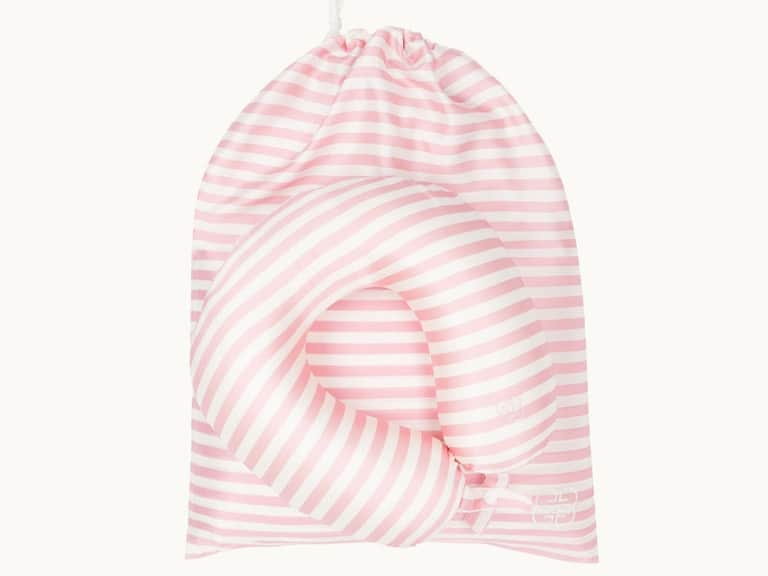
Gingerlily’s Silk Laundry Bag in Pink & Ivory Stripe is an example of a textile accessory whose stated function includes organizing laundry during travel. It is made from Mulberry silk, listed as 19 Momme, and measures 21 by 16 inches; its product information describes a drawstring closure and machine washing on a delicate cycle at no more than 30°C, followed by air drying. Those details are relevant because they show how a textile item can have a continuing role beyond the moment of purchase. They should not be taken as evidence of the packaging used for that item, or of packaging specifications for Gingerlily products generally.
The example also helps clarify a useful distinction. A silk laundry bag is a product, not a paper package. Yet retailers selecting packaging for delicate textile goods can ask whether any component of the purchase can remain useful after opening. Sometimes the answer is an existing product pouch or storage sleeve; sometimes it is not. If a reusable element is included, its material, care instructions, durability, and intended use should be communicated plainly. Reusability is a practical property, not a mood conveyed by a drawstring.
Recycling guidance should be local and legible
Retailers often want to tell customers what to do with packaging once the product has been unpacked. The right advice depends on the package’s actual composition and the collection system available to the customer. Clean, uncoated paper may be accepted in some curbside programs, while laminated or mixed-material formats may be treated differently. Handles, labels, windows, and adhesive components can affect what local facilities accept. It is better to give careful, qualified guidance than a sweeping instruction that sounds confident but may not apply.
When practical, keep packaging materials easy to separate. A paper bag with a removable label is easier to sort than a package in which several materials are permanently combined. If the customer needs to remove a handle or separate a window, say so plainly and only where that instruction is accurate for the relevant format. For businesses selling in multiple regions, a single global disposal label may not tell the whole story. A link or short note directing customers to local recycling guidance can be more honest and more useful.
Paper should also be protected from contamination if it is intended for recycling. Food residue, oil, moisture, and certain coatings may change what can be recovered. A paper package that has been used as a clean retail carrier is not necessarily treated the same way as a paper product contaminated during another use. The retailer’s role is not to promise a perfect circular journey, but to make the material choices and disposal information as clear as possible.
A practical checklist for retailers
Before choosing a paper-based package for premium or delicate goods, a retailer can ask a compact set of questions. The answers will differ from product to product, but the discipline of asking them tends to expose unnecessary complexity.
- What needs protecting? Identify the textile’s surface, structure, accessories, and likely vulnerabilities.
- Where does protection matter most? Distinguish storage, shipment, shop-floor handling, and customer carry-out.
- Does the package fit the packed item? Test the real dimensions, including folds, inserts, and closures.
- Are the handles and base suitable? Consider expected weight, handling, and how contents move when lifted.
- Is every insert doing useful work? Remove components that add bulk without improving protection, presentation, or use.
- What is the material made of? Request precise information about paper grade, coatings, recycled content, and other components.
- What can the customer do afterward? Verify local recycling advice and explain any separation steps clearly.
- Has the package been tried in practice? Pack, carry, open, and repack the item before committing to a large order.
Small trials can be more revealing than elaborate claims. A retailer might test a few sizes, observe how staff pack the product, and note whether customers need assistance. Packaging should be evaluated in motion: lifted by its handles, placed in another bag, opened in a hallway, stored in a drawer. The theatrical moment of unboxing matters, but so do the ordinary seconds that follow it.
The quiet measure of good packaging
The best package for a delicate textile is rarely the most complicated one. It is the one that protects the item against the risks it is likely to meet, fits without forcing, feels comfortable to carry, and communicates its material story without overstatement. For some products, that may mean a substantial paper carrier with reinforced handles. For others, it may mean a simple outer bag around a separately protected item, or no retail bag at all when the customer does not need one.
Gingerlily is a useful point of departure because silk makes the questions visible. The fabric asks for care, but care does not necessarily mean layers upon layers. A well-chosen paper package can support the experience of buying a delicate textile while remaining practical for the retailer and intelligible to the customer. Its success is measured not by how much material it contains, but by whether the product arrives as intended and whether the package makes sense afterward.
That is a modest standard, and a demanding one. It requires the retailer to know the product, understand the route it travels, and resist the familiar urge to let appearance stand in for performance. A bag is a small object, but it sits at the meeting point of material, commerce, and habit. Chosen carefully, it can protect the textile without trying to become the story.